
By Ashley Stender | October 31, 2025
In C-SPIRIT’s six-aim research pipeline, each discovery builds on the last, moving step by step toward real-world impact. That transition from controlled environments to working farms defines Aim 5: Lab and Field Testing, led by Dr. Addie Thompson at Michigan State University. Her team connects the molecular breakthroughs of Aims 1-4 with the field-scale experiments that reveal how those insights perform in living crops. By testing bioactive compounds under authentic growing conditions, Aim 5 helps turn discovery into resilience that boosts crop productivity and, ultimately, stabilizes our food supply.
“It’s really about taking what’s discovered in the lab and actually testing it out in the field, on the crops, in the environments where they grow, and seeing if what was predicted actually holds up,” Thompson explains.
Roots in Resilience
When Addie Thompson joined the Plant Resilience Institute (PRI) at Michigan State University in 2018, she brought with her a deep interest in how crops respond to environmental stress. At PRI, her lab studies genetic variation and physiological traits that influence how maize and other crops such as sorghum and dry bean perform under changing conditions. Her group combines field phenotyping, quantitative genetics, and modeling to understand how plants translate stress into measurable changes in growth and yield. That focus on linking genes, traits, and environments positioned her perfectly for C-SPIRIT’s mission.
Thompson’s introduction to C-SPIRIT came in March of 2025, when C-SPIRIT Director Sue Rhee invited her to join a site visit to Japan.
“When the faculty in C-SPIRIT were going to do a site visit to Japan, Sue opened it up, and I thought that sounded pretty exciting, so I decided to go with her,” she recalls.
During that trip, she presented her research and met collaborators at the RIKEN Center for Sustainable Resource Science, including the C-SPIRIT Japan Team Lead Motoaki Seki. It was then that Thompson realized her field-scale expertise could complement the molecular and computational strengths of the Japan team.
“While I was there, it became kind of clear that there were roles that I could play on the field side of things at MSU that were capabilities that Japan maybe didn’t have available,” she says.
In August, Thompson welcomed Miyo (Yamane) Fujimaki, a visiting scholar from the RIKEN Center for Sustainable Resource Science. As Aim 5’s ethanol trials moved forward at Michigan State, Fujimaki’s research provided an additional layer of genetic and physiological insight. Fujimaki’s work explores how ethanol-based global agricultural optimization (EGAO) can improve maize tolerance to drought, heat, and salinity. Using drone imagery, chlorophyll readings, and grain-yield data across diverse maize lines, she is helping reveal the mechanisms behind ethanol-induced stress resilience. Her collaboration strengthens the link between MSU and RIKEN, reinforcing Aim 5’s role as a bridge between discovery science and applied field testing.
Testing Maize Under Stress
Aim 5’s ongoing experiments have been designed to test how discovery translates to performance. The maize ethanol trials at Michigan State University stand at the heart of that effort. At the Mount Hope and Hagadorn research farms, Thompson’s team applied five-percent foliar ethanol sprays to maize grown under low-nitrogen, non-irrigated conditions, evaluating how the treatment influences resilience under environmental stress. Drone flights captured canopy imagery throughout the season, while handheld sensors measured chlorophyll content and leaf greenness.
“We were prioritizing a foliar spray because it seemed like the most practical approach from the farmer’s standpoint,” Thompson explains. “Not everybody has their fields under irrigation, for example.”
To ensure precision, researchers used large plastic panels to block overspray and followed certified-applicator procedures for any regulated treatments. Ethanol, she notes, was a useful starting point because it is safe, inexpensive, and familiar. “It’s a very innocuous substance, and so we didn’t have any concern about lingering presence in the soil or impact on anything else in the system.”
Alongside the field trials, Thompson’s team conducted complementary greenhouse experiments at MSU to monitor root and shoot responses under controlled conditions. The two efforts ran in parallel, providing both physiological and environmental perspectives on ethanol’s effects. Data collected from chlorophyll readings, biomass measurements, and yield analyses are now being compared with genetic and metabolic markers to understand how ethanol influences stress responses across maize varieties.
By aligning molecular, physiological, and environmental data, these studies are revealing how bioactive compounds influence resilience across complex agricultural systems.
Simulating Heat for a Changing Climate
While maize serves as Aim 5’s primary testing platform, Thompson also collaborates with colleagues at MSU’s Montcalm Research Center to study how potatoes respond to rising temperatures. Working with C-SPIRIT members David Douches, Chris Long, Nick Schlecht, and Kathe Rivera-Zuluaga, as well as members of the MSU Extension team, the group uses rainout structures to raise daytime and nighttime temperatures by two to eight degrees Celsius, roughly 38 °C during the day and 24 °C at night. These shelters simulate mid-century climate conditions, allowing researchers to evaluate how temperature shifts affect plant physiology and yield.

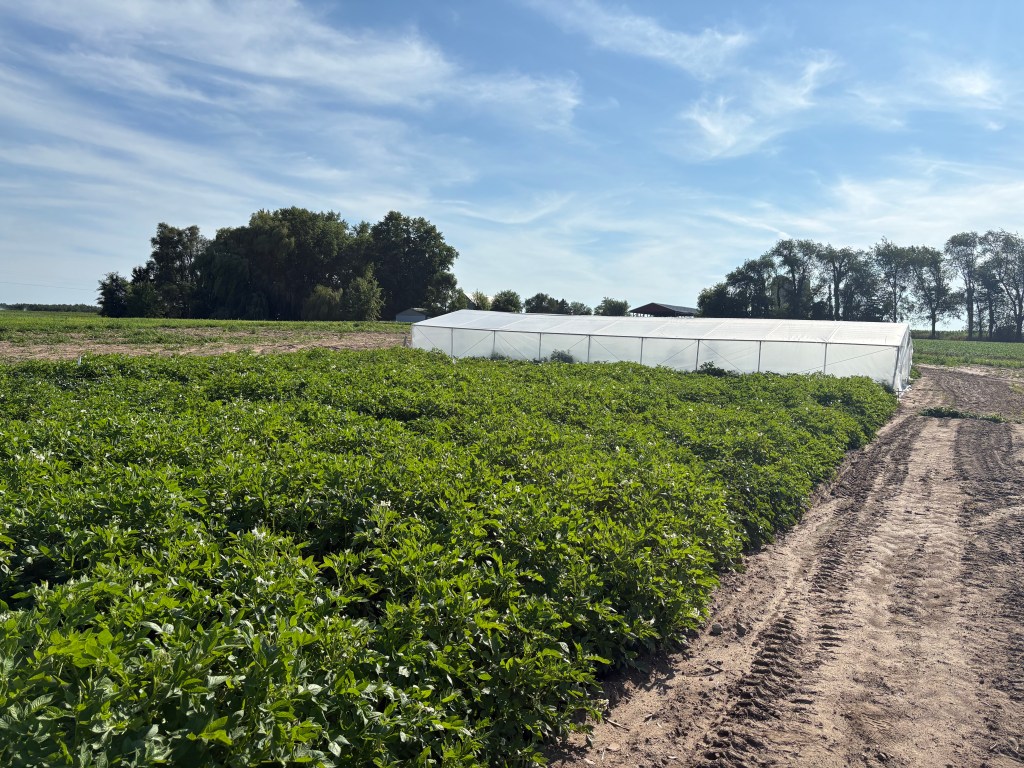
Two potato varieties anchor the study: Mackinaw, which is more heat-tolerant, and Snowden, which is more sensitive. Researchers measure photosynthesis, canopy temperature, and tuber development, collecting tissue samples for metabolomic and transcriptomic analysis. “They’re screening those varieties to try to identify natural compounds to then test,” Thompson adds.
Together, the maize and potato studies capture Aim 5’s central purpose, connecting discovery to application across different systems and scales.
Challenges in the Open Air
Field science brings its own complications. “There’s so much that’s unknown,” Thompson says. “We’re working with unknown compounds with unknown toxicity and unknown effects.” Safety and environmental protection guide every step. For any regulated compound, the team follows certified pesticide-applicator protocols and uses physical barriers to prevent drift.
Weather adds another layer of uncertainty. Michigan’s rainfall makes drought studies unreliable, so Thompson plans to install rain-out shelters for future trials. “We don’t get reliable drought in the state of Michigan,” she explains. Equipment logistics have also tested the group’s adaptability.
“We now own two backpack sprayers,” Thompson says with a laugh. “We ended up buying them at the last minute just to get the fieldwork underway.”
Behind these practical adjustments lies a broader scientific challenge: integrating physiological data, omics profiles, and environmental measurements into one coherent picture. A new computational postdoc at MSU will help bridge that gap, ensuring that the next generation of analyses connects field observations to molecular mechanisms.
Looking Beyond the Horizon
With harvest season underway, Thompson’s group is processing maize yield data that will determine Aim 5’s next steps. If results are promising, larger multi-site trials could begin in 2026. As new bioactive compounds emerge from earlier C-SPIRIT Aims, Aim 5 will evaluate them across maize, potato, soybean, and other crops, while Aim 6 prepares to handle toxicity and safety validation once field material becomes available.
“Although we’re just starting to see the data come in, each trial gets us closer to understanding how these compounds can help real crops cope with stress,” Thompson says.
Her vision extends beyond C-SPIRIT itself. The methods and facilities developed at MSU are laying groundwork for broader agricultural applications. As researchers around the world search for ways to build resilience into food systems, the integrated testing platforms that Aim 5 has created could become models for sustainable crop development. Thompson believes the real power of the work lies in its cumulative progress.
“Even if each trial only teaches us a little, together they’ll change how we think about resilience,” she reflects. “This is where biological ideas become agricultural reality.”
 C-SPIRIT