
Aim 4: Biological Synthesis of Bioactive Compounds
Our Biological Synthesis aim focuses on producing bioactive compounds through advanced synthetic biology. Many useful natural products are produced in small quantities or as part of complex mixtures, which limits their accessibility and practical applications. By engineering microbial and plant systems, we aim to produce key compounds at scale, supporting sustainable agricultural practices.
Research Goals & Approach
1. Engineering Microbial and Plant Systems for Synthesis
We focus on engineering microbial systems such as Escherichia coli, Streptomyces, and Saccharomyces cerevisiae to synthesize bioactive compounds like anthraquinones, coumarins, and monoterpenes. These microbial platforms are ideal for scalable production due to their amenability to genetic modification and optimized metabolic pathways. For plant-based systems, Nicotiana benthamiana serves as a versatile chassis, offering natural compatibility for producing certain metabolites while requiring minimal cultivation resources. This dual-platform approach allows us to capitalize on the unique advantages of both microbial and plant systems for synthesizing compounds critical to agricultural and industrial applications.
2. Optimizing Production Pathways
To enhance production yields, we employ advanced metabolic engineering techniques that optimize pathway flux, enzyme efficiency, and cofactor availability. For example, we improve microbial pathways by introducing feedback-resistant enzyme variants and optimizing expression levels. Plant systems are optimized through metabolic engineering of precursor pathways and the removal of competing enzymatic activities. These targeted modifications ensure the efficient synthesis of high-value compounds like triterpenoids and diterpenoids, which hold significant promise for sustainable agriculture and crop protection, supporting the commercial viability of these innovations.
3. Bioengineering Combinatorial Libraries
To generate diverse bioactive compounds, we employ combinatorial synthesis by co-expressing terpene synthases with libraries of cytochrome P450s, acyltransferases, or glycosyltransferases. These combinations allow us to tailor bioactivity and physical properties to meet specific agricultural needs, such as enhanced pest resistance or crop resilience. By iterating through Design-Build-Test-Learn cycles, we produce panels of structurally diverse molecules. Improved annotation methods enable us to identify productive enzyme combinations and decipher the activities of newly characterized pathways. This approach fosters the creation of novel bioactives with significant agricultural and industrial potential.
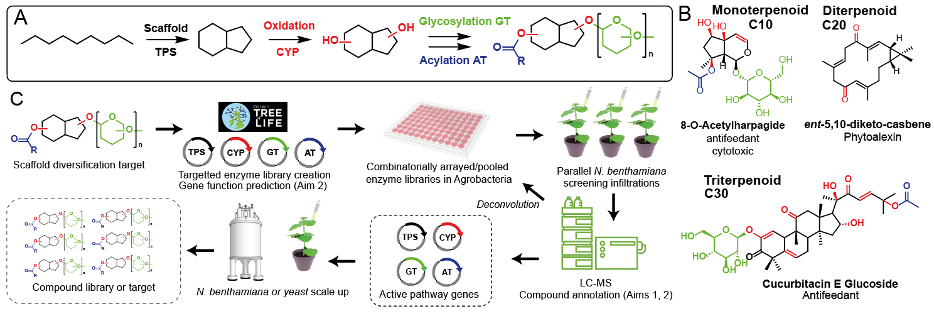
Terpenoid diversification strategy: A. General scheme of terpenoid biosynthesis, B. Example terpenoid targets with antifeedant properties, C. Workflow for terpenoid library generation.
Outcomes & Impact
This research will yield engineered microbial and plant systems capable of producing essential bioactive compounds at scale. Expected outcomes include new tools for optimized gene expression and production, expanded enzyme libraries, and innovative bioactive compounds designed for specific agricultural applications. Through these advancements, we pave the way for environmentally friendly, bio-based solutions to meet agricultural needs.
 C-SPIRIT