
Research
C-SPIRIT’s six-aim research pipeline—powered by advanced computational tools and machine learning—drives the discovery and application of plant and microbial compounds to enhance crop resilience and reduce synthetic inputs. To reach our overall goal of bringing sustainable solutions for agriculture to the public, we have divided our research efforts into six different aims.
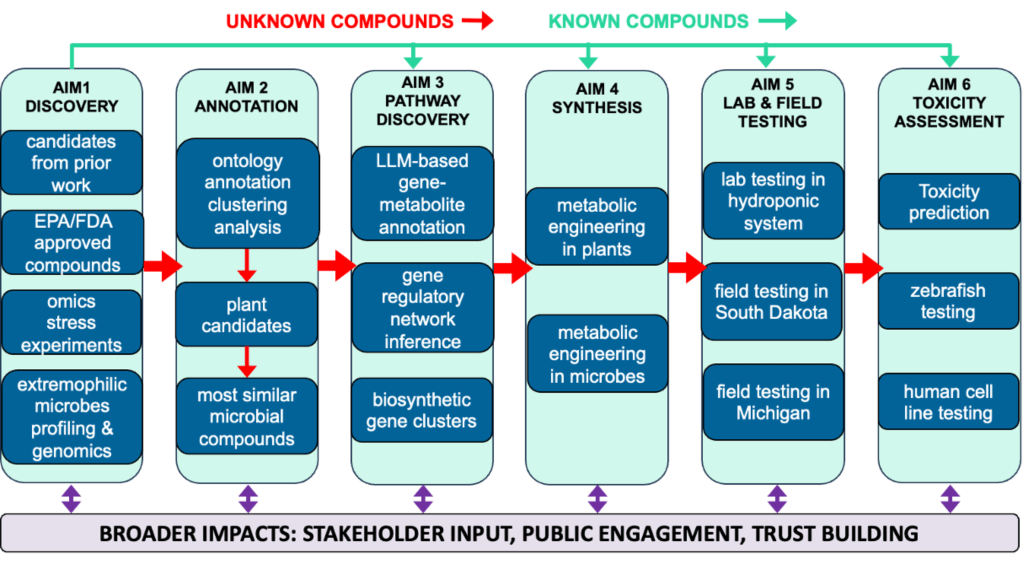
Aim 1: Metabolite Discovery
Goal: Identify bioactive compounds that strengthen crop resilience.
- We sample metabolites and genes from plants and microbes under stress conditions
- By combining known and novel compounds, our researchers prioritize metabolites that show promise in crop protection against stressors such as drought, pests, and pathogens
- We explore unique compounds from soil, plants, and polar microbes to build a library of candidate bioactive molecules for further study
Aim 2: Metabolite Annotation & Database Development
Goal: Create a robust database for plant and microbial metabolites.
- We develop a classification system to annotate metabolites with details on structure, function, and source
- Using advanced machine learning tools, we catalog and prioritize bioactive compounds, establishing a valuable resource for researchers worldwide
- This resource supports downstream research and real-world applications in agriculture, sustainability, and bioeconomy
Aim 3: Gene & Pathway Discovery
Goal: Identify and understand the genetic pathways responsible for metabolite production.
- We leverage AI and genomics to map gene-metabolite relationships, especially for compounds essential to crop resilience
- Through modeling and analysis, we identify and connect relevant biosynthetic genes and enzymes, setting the stage for further engineering and synthesis
- This knowledge enables future development of novel agricultural products through synthetic biology
Aim 4: Biological Synthesis of Bioactive Compounds
Goal: Produce bioactive compounds in sustainable, scalable systems.
- We use microbes and plants to synthesize compounds that aid in crop resilience, reducing dependence on non-sustainable inputs
- Techniques in metabolic engineering allow us to enhance the production of target molecules, making these compounds more accessible for agricultural applications
- Our work provides natural alternatives for pest management, drought resistance, and more, supporting sustainable farming
Aim 5: Lab & Field Testing
Goal: Test compounds for efficacy in improving crop health and resilience.
- We evaluate selected compounds in controlled lab settings to assess their impact on crop growth, nutrition, and resistance to environmental stressors
- Field trials across various crop systems help us confirm the practical benefits of these compounds and refine application methods
- Our approach emphasizes collaboration with growers to ensure real-world relevance and adoption
Aim 6: Environmental & Animal Toxicity Assessment
Goal: Ensure the environmental and ecological safety of bioactive compounds.
- We assess each compound’s potential environmental impact using computational models and lab tests
- Toxicity studies in model organisms like zebrafish and human cell lines help determine safe exposure levels
- Collaborations with toxicologists ensure that our solutions are safe for both the environment and public health
 C-SPIRIT