
Aim 1: Metabolite Discovery
Our Metabolite Discovery aim focuses on tapping into the vast diversity of plant and microbial metabolites—compounds that remain largely unexplored but hold tremendous potential for enhancing crop resilience. This research aims to identify and catalog bioactive compounds that can protect plants against various stresses, including drought, pathogens, and temperature extremes.
Research Goals & Approach
1. Cataloguing Known and Novel Compounds
Our efforts begin by curating and annotating thousands of bioactive compounds identified through the extensive research expertise of our Center members. These compounds include structurally known classes, such as dipeptides, cyclic-dipeptides, flavonoids, and natural metabolites that regulate plant resilience. For example, flavonoids play critical roles in carbon flux regulation, while benzyl isothiocyanate has been shown to improve drought tolerance by inhibiting stomatal opening. Additionally, compounds from specialized repositories, like the RIKEN Natural Products Depository, are leveraged to identify potential resilience-enhancing candidates. The catalog is further enriched by novel metabolites discovered in extracellular vesicles from plant-microbe interactions and soil volatiles, contributing to a comprehensive database. This robust catalog serves as the foundation for pathway discovery, metabolite engineering, and field testing in downstream aims.
2. Discovering New Compounds in Response to Stress
To uncover stress-responsive metabolites, we employ advanced multi-omic technologies, including high-resolution mass spectrometry (HRMS) and RNA sequencing, to analyze the metabolite and transcript profiles of crops under controlled stress conditions. Six key crops—corn, soybean, rice, potato, pennycress, and cassava—are exposed to abiotic stresses like drought and heat, as well as biotic factors like flagellin, jasmonic acid, salicylic acid, and nematodes. Coordinated sampling across roots and leaves at multiple time points ensures high-resolution insights into stress-specific metabolic signatures. These signatures are co-clustered with induced transcripts to identify potential regulatory pathways. This approach not only maps critical stress-induced compounds but also establishes their linkages with underlying genetic and metabolic pathways, paving the way for novel resilience strategies.
3. Exploring Microbial Metabolites
We investigate unique compounds produced by extremophilic microbes from polar regions, where harsh conditions drive the evolution of specialized metabolites. In collaboration with the Korean Polar Research Institute, we analyze the genomes and metabolomes of approximately 300 microbes isolated from Arctic and Antarctic environments. Using HRMS, we generate detailed metabolomic fingerprints for each species under standard growth conditions. These analyses aim to identify metabolites with potential applications in enhancing crop resilience. Although the direct path to agricultural application may be longer for these microbial-derived compounds, they are crucial for identifying biosynthetic gene clusters and engineering pathways for novel bioactives. This integration of microbial diversity enriches our catalog and provides valuable leads for future research in metabolic engineering and resilience strategies.
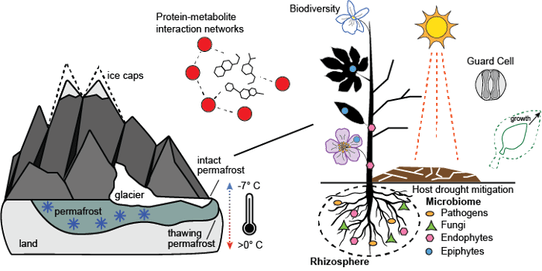
A schematic representation of sample collection from diverse ecosystems, across plant species and stress conditions. We will also tap to the existing datasets, such as those that highlight protein-metabolite interactions.
Outcomes & Impact
Our metabolite discovery process will generate a comprehensive list of bioactive compounds with potential applications in crop stress resilience. These compounds will be prioritized based on their structural properties, stress response patterns, and relevance to agricultural needs. The most promising candidates will advance to the next research phases, where they undergo pathway discovery, synthesis, and field testing.
Through this initiative, we aim to bridge the gap between natural metabolic diversity and practical solutions for sustainable agriculture, offering new tools to protect crops and ensure food security in the face of climate change.
 C-SPIRIT