
By Ashley Stender | May 29, 2026
Scientific discovery increasingly depends on the ability to generate enormous amounts of data. But in the plant sciences, generating large datasets is only part of the challenge. Researchers also need ways to collect, compare, visualize, and implement them to ask better questions.
Led by Nicholas Provart at the University of Toronto, the Provart Lab helps address this challenge within C-SPIRIT by developing tools that make plant biology data easier to access and interpret. C-SPIRIT team members Asher Pasha and Vincent Lau, research associates in the Provart Lab, support the data visualization and resource development efforts described throughout this spotlight. As C-SPIRIT researchers study bioactive compounds, stress responses, crop systems, metabolites, and gene expression, the lab’s work helps turn complex datasets into user-friendly resources that can be explored across labs, species, and research aims.
Making Data Easier to Use
The Provart Lab’s role in C-SPIRIT builds on a long-standing focus on plant bioinformatics and community data resources. Provart’s path into bioinformatics began during his early-career work in plant molecular biology, when he managed a plasmid database at a small startup after completing his Ph.D. program. What started as a practical need to organize information became a larger interest in helping researchers work with biological data more efficiently.
“At first, that was an Excel sheet,” he says. As web tools became more common in the late 1990s, Provart began learning how to move that information online. This eventually led to the creation of the Bio-Analytic Resource for Plant Biology, or BAR, a platform that began as an online resource for plant gene expression data and has since expanded to include other plant biology data and visualization tools.
BAR reflects the lab’s broader approach to plant science: data become more valuable when researchers can explore them in context. Rather than treating results as a static output of an experiment, the Provart Lab develops tools that allow users to move through information visually, compare patterns, and generate new questions.
One of the “bigger vision” pieces of the lab’s work, Provart says, is “trying to make those sorts of datasets accessible, integrated into one interface, so you don’t have to learn different interfaces.”
Building Shared Viewers for C-SPIRIT Crops
“Our goal is to help make the datasets that are being generated by C-SPIRIT easily accessible,” Provart says.
One way the lab is doing that is by building crop-specific ePlant viewers. The Provart Lab has already developed a Potato ePlant viewer, which gives researchers a visual way to explore how genes behave across tissues, treatments, and stress conditions. Instead of starting with raw data files, users can search for a gene of interest and quickly see where it is active, how its expression changes, and whether it may be responding to stress. Additional viewers will be developed for other C-SPIRIT crops, including pennycress.
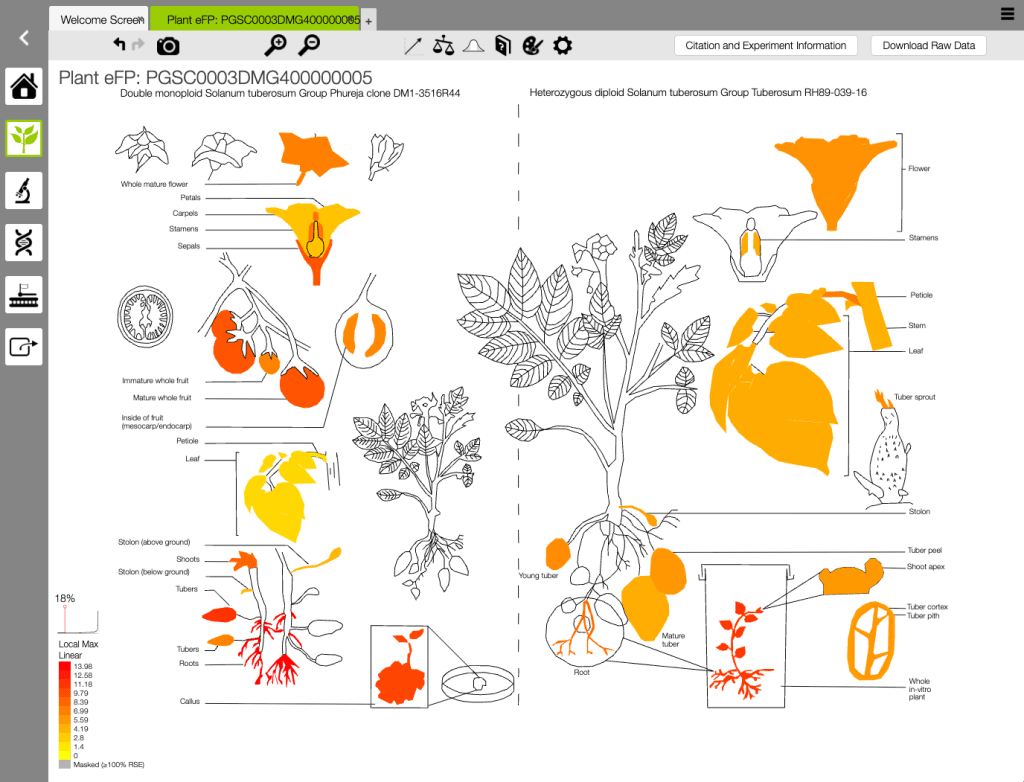
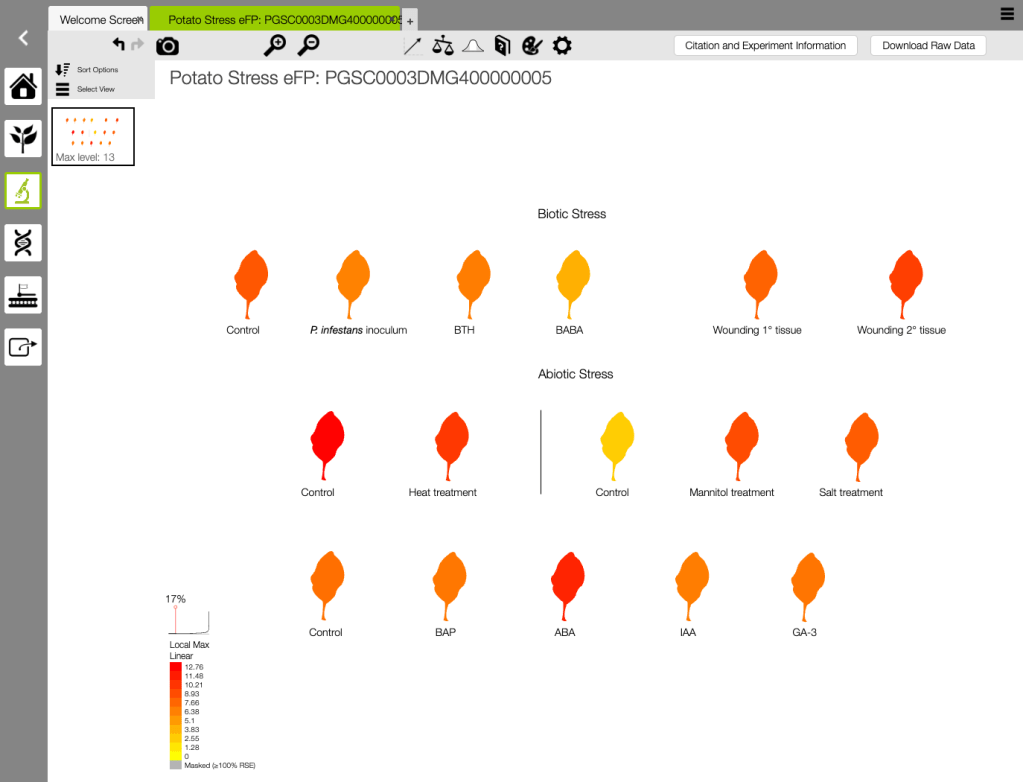
If a C-SPIRIT team generates transcriptome data from potato cultivars under abiotic stress, for example, that data can be added to the viewer. A researcher could then compare how a gene responds across cultivars, treatments, or conditions.
Looking Across Genes, Cells, and Metabolites
The Provart Lab’s C-SPIRIT work extends beyond crop-specific ePlant viewers. The lab is also developing single-cell viewers, building on work connected to the Plant Cell Atlas, along with metabolite viewers that will help researchers examine different layers of plant data more precisely.
Single-cell viewers allow researchers to examine gene expression in specific cell types rather than only in whole tissues. That matters because a stress response or compound effect may be strongest in a particular cell type, tissue region, or developmental stage. In the context of leaf data, Provart explains, these tools can help researchers see “which parts of the leaf are responding differently to different stresses.”
Metabolite viewers add another layer. As C-SPIRIT researchers identify metabolites that may be stress-induced or chemically induced, visualization tools can help show where those compounds appear and how they may relate to plant resilience. Together, these viewers give researchers clearer ways to move between data types that are often studied separately, including genes, metabolites, tissues, stresses, and crop systems.
Connecting the Moving Pieces
As C-SPIRIT generates new data, the Provart Lab’s tools are designed to grow with the center. Data from crop viewers, single-cell studies, metabolite analyses, stress experiments, and field trials can be added over time, giving researchers new ways to explore results as the project develops.
That flexibility matters because C-SPIRIT’s research is unfolding across many connected areas at once. A field trial, a metabolite dataset, a stress experiment, and a gene expression study may each answer different questions. Shared viewers can help researchers move between those pieces and ask how results from one part of the center might inform another.
For Provart, part of what makes C-SPIRIT exciting is seeing the center’s many research efforts begin to take shape at the same time.
“It’s nice to see field trials running and compounds being explored,” he says. “It really is a lot of different moving pieces.”
From Center Datasets to Community Resources
The same tools that help C-SPIRIT collaborators explore one another’s results can also extend the value of the center’s work beyond a single project. A team may generate a dataset to answer one question, but another researcher may later use it to examine a metabolite, compare stress responses, or explore a gene of interest in a different context.
“The strength of C-SPIRIT is generating these datasets and then making them available to the wider plant research community,” Provart says.
By placing C-SPIRIT data into shared viewers, the Provart Lab helps turn individual results into resources that can be explored by collaborators first, and eventually reused by researchers outside the center. Over time, those resources can support new questions, with the potential to expand the impact of the current research to other crops, organisms, and environmental conditions.

